
Last fall, Apple made waves with the rollout of Mail Privacy Protection (MPP) for their mail app on iOS 15, iPadOS 15, and macOS Monterey devices. Immediately after this announcement, the Omeda team began testing Mail Privacy Protection to determine how total open rates would be affected. Now, a few months later, we have results that show the real impact of the MPP feature.
What is Mail Privacy Protection & How Does it Work?
As a reminder, Mail Privacy Protection (MPP) stops email senders—like Omeda—from using invisible tracking pixels to collect information about the user. When Mail Privacy Protection is enabled, Apple’s proxy servers will download a pixel when the application is opened and the mailbox is updated. This pixel download then indicates to ESPs like Omeda that the email has been opened.
This new feature helps users prevent email senders from knowing when they open an email. It also masks their IP address so it can’t be linked to other online activities or used to determine their location.
What this means is if a user were to turn on this feature, we can no longer accurately show an “open” from someone who is using the Apple Mail App to view emails. In fact, initial tests showed the possibility of open rate inflation.
Omeda’s Initial Test Results
Through our initial testing before the wide rollout of MPP, we found that open rates were inflated for clients with recipients using Apple Mail on an iOS device that has been updated to iOS 15 and have opted-in to the Mail Privacy Protection feature. For the full details and findings from our initial tests, read this blog.
The Actual Data, 3 Months Later
Now that Apple’s MPP is up and running, we wanted to see what the reality is since our initial research. Our first step was to review the “before” and “after” trends to see the change in tracking on real open rate data.
In the chart below, you’ll see the date ranges of the data collected and the impact of MPP thus far:
| Metric – All Sends | 7/19 – 9/17 (Before MPP) |
9/27 – 11/26 (After MPP) |
| Delivery Rate | 98.5% | 98.2% |
| Total Open Rate | 22.4% | 27.3% |
| Unique Open Rate | 15.2% | 19.1% |
| Total Click Rate | 2.4% | 2.1% |
| Unique Click Rate | 1.6% | 1.4% |
| Total CTR | 10.8% | 7.6% |
| Unique CTR | 10.5% | 7.2% |
The chart above reflects the impact of Apple’s Mail Privacy Protection before and after its release.
A note on email volume: These ranges include over 40,000 deployments both before and after the introduction of Apple’s MPP, and over one billion emails sent during both timeframes. At these high volumes, we’re able to more accurately identify trends and understand the full impact of MPP.
While a lot of data is shown in the chart above, the two most relevant data points to focus on are the areas that MPP can actually impact—unique and total open rates. When comparing the data before MPP and after, we found that, that unique open rate went up by four percentage points, from 15% to 19% and, the total open rate rose to 27% from 22% before MPP.
This shows that our initial tests and predictions were correct—total open rates are rising as a result of MPP, but we can’t consider them reliable. Any data—such as click through rate (CTR)—utilizes the total open rate data and is not as reliable as it once was. In fact, it will continue to get distorted more over time as more data is collected.
However, we found that the total clicks and unique click rate are valid and not impacted by MPP. This major impact is on open rates, not click rates.
Below, you’ll find a deeper view into the data, broken down by email designation type:
| Content Type | Date Range (Before & After MPP) |
Total Open Rate | Unique Open Rate | Total Click Rate | Unique Click Rate | Total CTR | Unique CTR |
| Third Party & Advertiser | 7/19 – 9/17 9/27-11/26 |
20.9% 26.0% |
14.7% 18.6% |
0.9% 0.7% |
0.7% 0.5% |
4.3% 2.8% |
4.8% 2.9% |
| Audience Dev & Circulation | 7/19 – 9/17 9/27-11/26 |
21.5% 26.3% |
14.4% 18.2% |
1.8% 1.7% |
1.4% 1.3% |
8.4% 6.4% |
9.9% 7.3% |
| Digital Magazines & Reader Service | 7/19 – 9/17 9/27-11/26 |
23.5% 27.5% |
14.6% 17.9% |
2.3% 2.2% |
1.7% 1.6% |
9.8% 8.0% |
11.5% 8.9% |
| Events & Virtual Conferences | 7/19 – 9/17 9/27-11/26 |
18.6% 23.9% |
13.0% 17.1% |
0.7% 0.6% |
0.5% 0.4% |
3.7% 2.6% |
3.9% 2.6% |
| Marketing & Other Products | 7/19 – 9/17 9/27-11/26 |
17.9% 23.7% |
12.8% 17.3% |
1.1% 1.0% |
1.0% 0.9% |
6.4% 4.4% |
7.5% 5.0% |
| Enewsletters | 7/19 – 9/17 9/27-11/26 |
25.2% 29.8% |
16.7% 20.4% |
3.6% 3.1% |
2.2% 1.9% |
14.4% 10.5% |
13.4% 9.5% |
| Research & Surveys | 7/19 – 9/17 9/27-11/26 |
17.6% 23.3% |
12.5% 16.8% |
1.0% 0.7% |
0.8% 0.6% |
5.4% 2.9% |
6.5% 3.4% |
The chart above reflects the differences by content type before and after Apple’s Mail Privacy Protection release.
Below you’ll find definitions and how the data in the charts above were calculated:
| Metric | Calculation |
| Delivery Rate | Delivered / Sent |
| Total Open Rate | Total Opens / Delivered |
| Unique Open Rate | Unique Opens / Delivered |
| Total Click Rate | Total Clicks / Delivered |
| Unique Click Rate | Unique Clicks / Delivered |
| Total CTR | Total Clicks / Total Opens |
| Unique CTR | Unique Clicks / Unique Opens |
The chart above defines how each metric is calculated.
New Reporting to Understand the Impact of Mail Privacy Protection
In December 2021, Omeda released an update that allows clients to see the impact of Apple Mail opens in their deployments more clearly. Namely, we’ve made some changes to how these Apple MPP opens will display in the Opens by Client and Device Reports as well as how they can be selected in the Email Client section in Audience Builder.
The opens that are likely to be from those who have opted into MPP are listed now as “Mozilla/5.0” instead of within the Default Browser section. This should make it easier for clients to understand what opens are coming from Apple, without having to further delve into the reporting. An example of the report is shown below.
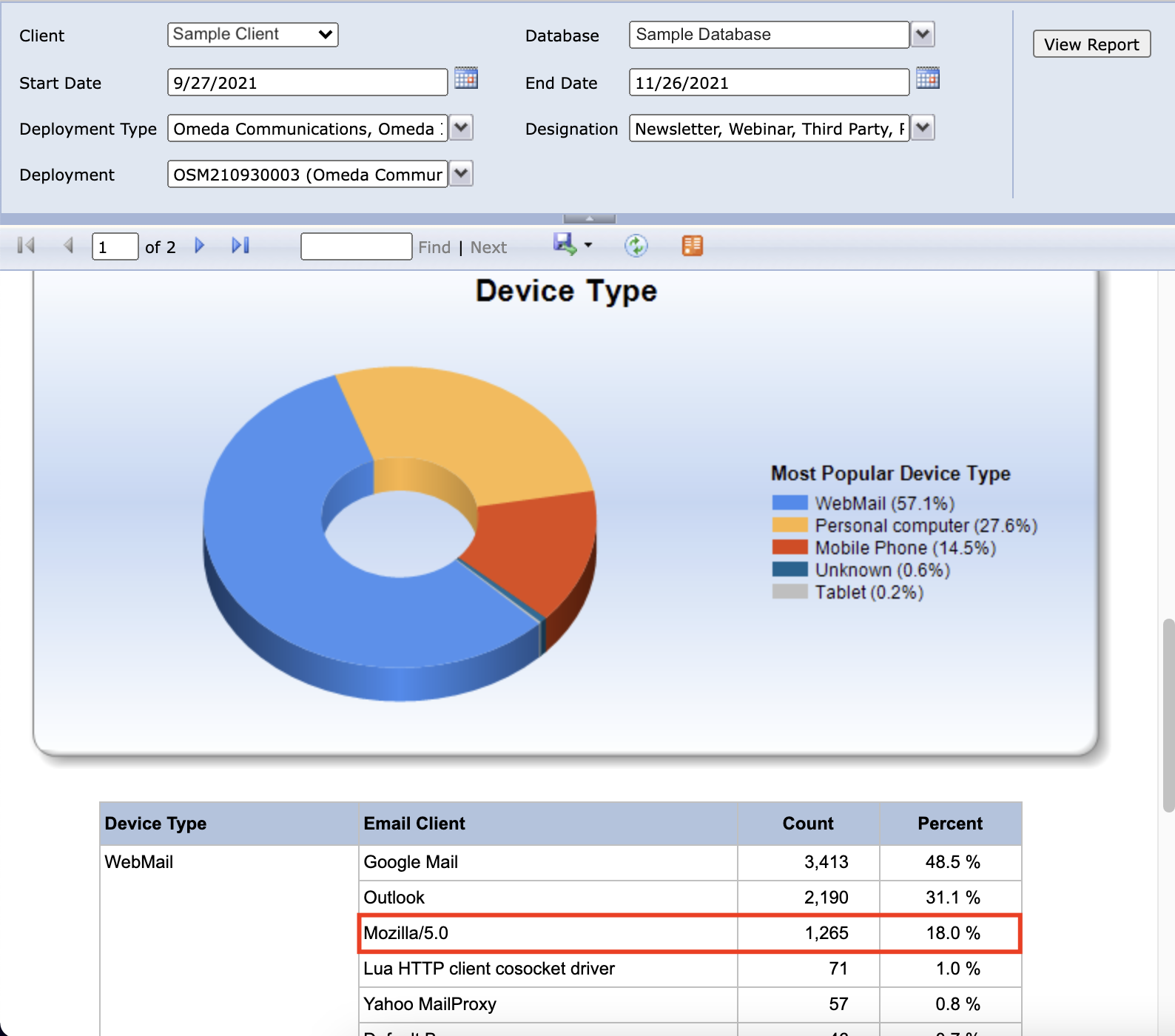
Quick tip: Before running the Opens by Client and Device report, use the drop-downs at the top to select the desired deployment details. Then, click View Report and scroll down to see your results.
What Else Can You Do?
We will continue to track these trends and encourage our clients to remain vigilant and follow email marketing best practices. While we’ll always use email metrics like sent, delivered, and opened to measure campaign effectiveness, they are just the tip of the iceberg around what we can include in our campaign reporting.
This is why we continue to develop our audience and first-party data to go beyond just an email address, so we are prepared when tracking capabilities are impacted. By understanding who our audience is and what they are looking for, we can deliver valuable multi-channel interactions to help ensure that the right message is delivered to the right person at the right time.
Additionally, we would advise clients to concentrate on metrics beyond these initial open and sent insights and dive further into conversion metrics and other ways that advertisers/sponsors are measuring campaigns.
We recommend reviewing this blog post, written by Omeda’s email marketing experts, which outlines 10 email marketing strategies that specifically help to address the challenges presented by MPP, including using behavioral-based segments, cleansing your database, A/B testing, and more.
In addition to our own blog, this excellent resource from Brief Media outlines 5 additional ways to pivot now that MPP is officially here, such as establishing KPIs beyond open rates and keeping lists healthy.
What Omeda Clients Are Saying
“A preliminary assessment of our newsletters in aggregate showed an increase from 22.07% pre-iOS 15 to 29.2% post for unique opens through the end of the year. Our greatest increase was 8.9%. For sponsored email messages, we’re seeing an average increase of 5%. Honestly, we had anticipated increases north of 10%, so we’re somewhat relieved (for now!) and will continue to monitor. One more important thing: In June, we established click through rates as the ‘measure of success’ for our newsletter editors. MPP gave that a rocket-boost up the learning curve!”
Joyce Neth, Vice President, Director of Audience Development & Research, WATT Global Media
The Omeda team will continually monitor the impact of MPP and provide ongoing updates. As needed, we’ll release additional enhancements to query data for the most accurate insights into email marketing performance.For more information about how to navigate through Apple’s Mail Privacy Protection, contact your Omeda Customer Success Manager or reach out to sales@omeda.com.
